I changed my mind about determinism
Also in: 探索决定论 →
Three months ago when I explored the concept of free will, I leaned strongly towards a deterministic view of the world.
My belief began to waver as I dove into complex systems and quantum theory. Although my grasp of these concepts is still in its infancy, I am excited to share my discoveries. I hope you find it as fascinating to read as I did to write.
Chaotic unpredictability #
Determinism sounds logical under Newtonian mechanics — if we know the initial conditions of a system (like the positions and velocities of all particles), we can predict its future behavior, and also retrodict its past.
This principle does not hold true in chaotic systems. Here’s an illustration from the book Determined.
Start off with a grid, like the one below, where the first row is your starting condition.
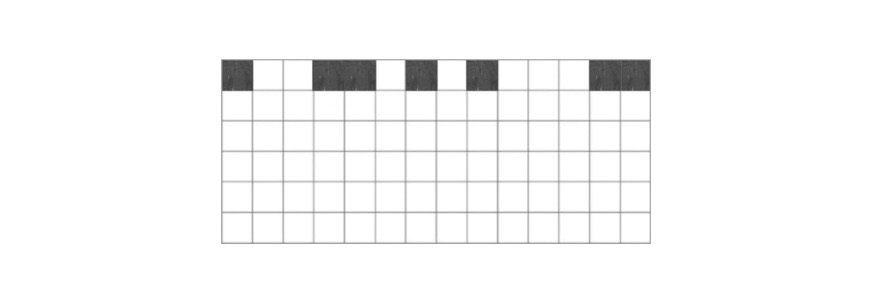
Determined by Robert Sapolsky (p. 135)
A simple rule to determine the row below: A box in the next row is filled if and only if one of the three of boxes above it is filled in. (For the first and last boxes, just look at the above two.) For example,
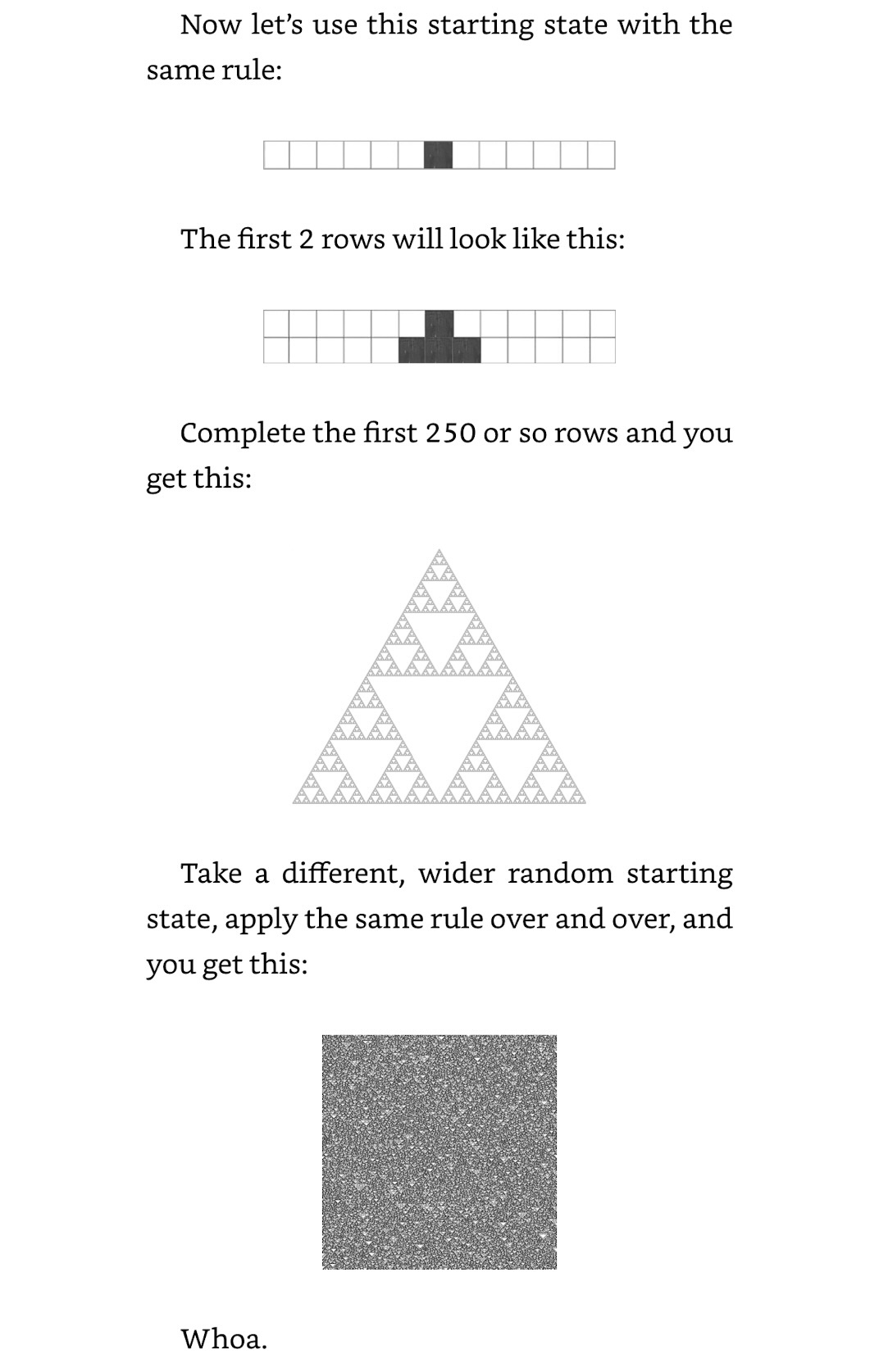
Now a challenge: Imagine what the pattern will turn out for each of the four.
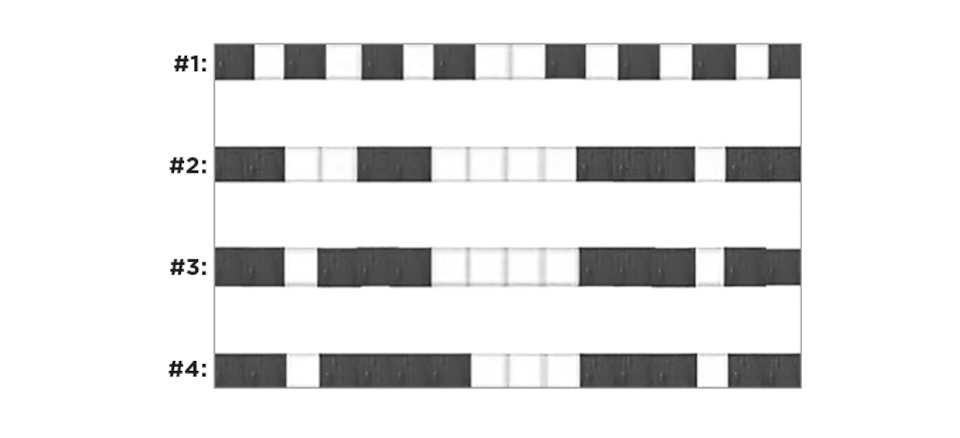
Well, yes, we can’t predict by staring at them. Same for computers — the pattern has to be worked out step by step, not calculated with some formula. Interestingly, pattern #1 and #3 will evolve into identical forms after several generations.
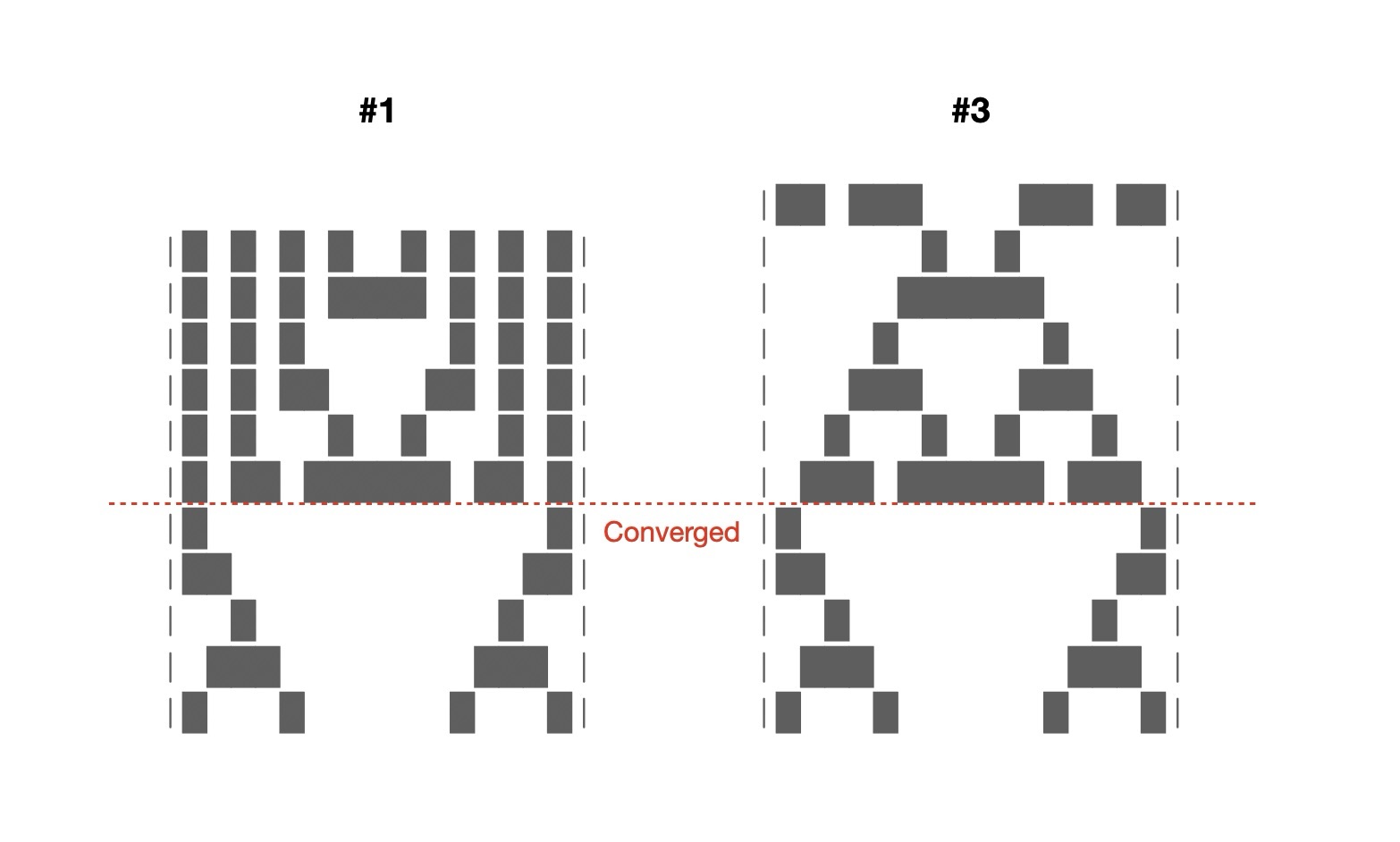
I wrote a little code to generate this
This reveals a key insight: knowing the rule and the mature state of a system gives us no predictive power as to what the starting state was — multiple different starting states could lead to the same outcome.
Counterfactuals #
Why was that interesting? Because that challenges causation.
For example, if each row represents one year of my life, at row 31 now I look back and tell how the past has shaped me (pattern #1). But a completely different “past” (pattern #3) could also have resulted in the same state. The actual stories could be completely different from the ones I told myself.
Another example: in computer simulations, a flap of a butterfly wing results in a hurricane. What if real hurricanes were not caused by butterflies? To say an event A causes an event B, B needs to happen after A and if A had not happened, B would not have happened (from the works of David Lewis). Because we can’t access alternative realities where A had not happened, it’s hard to establish solid cause-and-effects for historical events.
We can’t be certain about the causes because we can’t observe counterfactual events, but our complex system theories, like chaos theory, are still governed by the deterministic laws of classical physics. This implies that the effects are still determined by underlying causes, even if not apparent or could be mistaken. So to say the world might be indeterministic, we need help from quantum theory and a lot of conjectures.
Quantum indeterminism #
Science has only showed quantum effects in the microscopic world. We may conjecture what it would mean for the macroscopic world to obey quantum theory.
The following passage from The Fabric of Reality by David Deutsch offers an alternative explanation for the butterfly effects, invoking multiverse theory:
Consider a group of identical universes at an instant at which, in all of them, a particular butterfly’s wings have flapped. Consider a second group of universes which at the same instant are identical to the first group, except that in them the butterfly’s wings are down. Wait for a few hours. Quantum mechanics predicts that, unless there are exceptional circumstances, […], the two groups of universes, nearly identical at first, are still nearly identical. But each group, within itself, has become greatly differentiated. It includes universes with hurricanes, universes without hurricanes, and even a very tiny number of universes in which the butterfly has spontaneously changed its species through an accidental rearrangement of all its atoms, […] Even so, the two groups still resemble each other very closely. In the universes in which the butterfly raised its wings and hurricanes occurred, those hurricanes were indeed unpredictable; but the butterfly was not causally responsible, for there were near-identical hurricanes in universes where everything else was the same but the wings were lowered. (p. 202)
Instead of attributing weather unpredictability to initial conditions’ sensitivity in chaotic systems, Deutsch proposes an explanation rooted in the multiplicity of parallel universes: “Quantum systems do not have that sensitivity, but are unpredictable because they behave differently in different universes, and so appear random in most universes.”
Therefore #
The challenge in forming reliable causal chains from a single historical observation, combined with potential quantum effects on larger-scale events, has prompted me to reconsider the certainty of determinism.
I’m not yet convinced in indeterminism either. I’m just fascinated by how knowing a bit more questions my beliefs about determinism, causation, and reality. I has also led me to reconsider, for instance, our ways of interpreting the past and the narratives we construct about our lives, which has huge effects on our present and the future.
On this Week #
Implications of absence of free will #
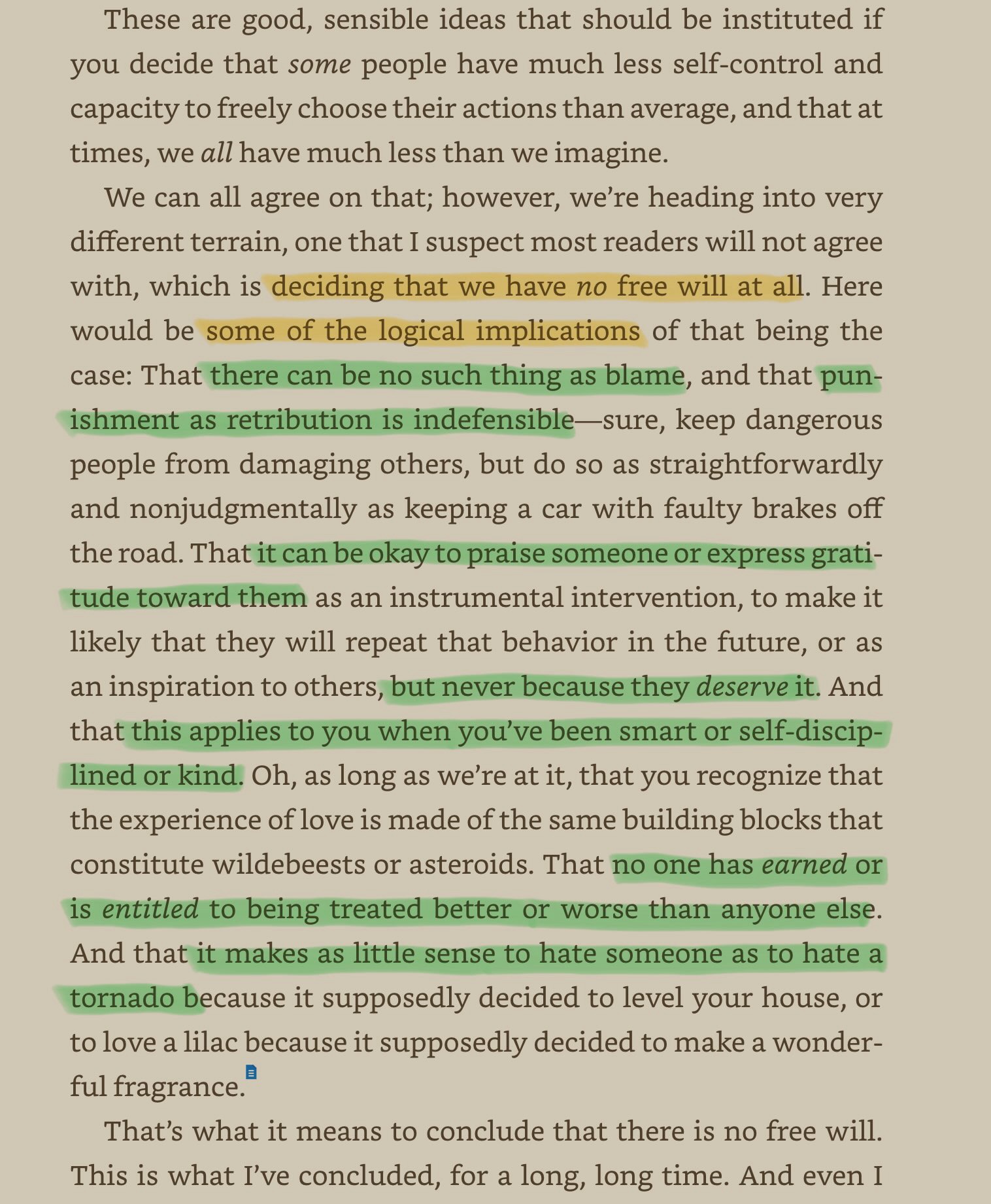
I still don’t believe we have free will though. A nice summary from Stanford neuroscientist Robert Sapolsky of what that means:
Determined: A Science of Life without Free Will
Karl Popper criticizing essentialism #
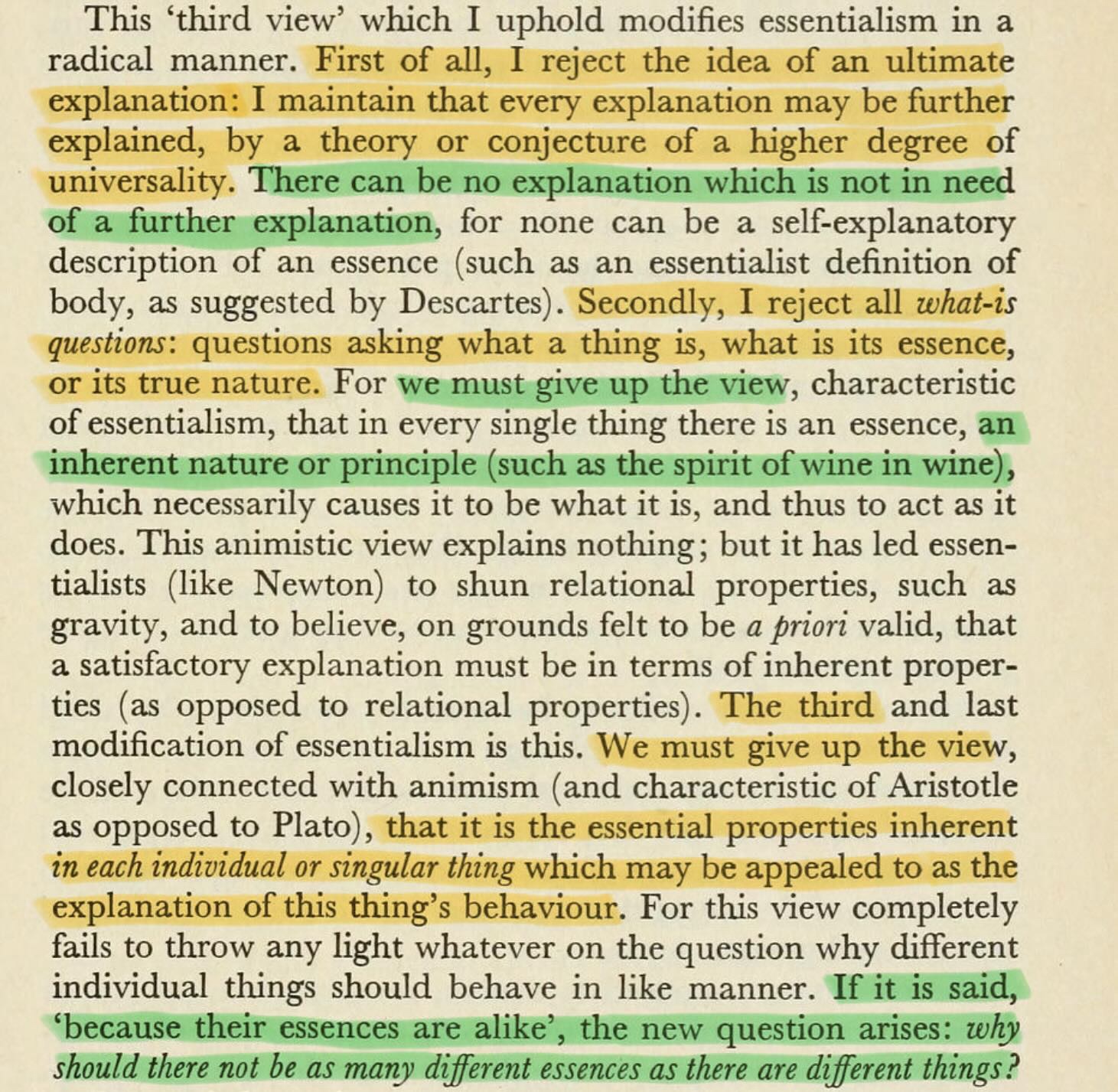
In everyday language we often say what-is: someone is smart or stupid. That is the danger of unexamined essentialism, as it obstructs change and progress.
Objective Knowledge: An Evolutionary Approach
Lastly #
The single biggest problem in communication is the illusion that it has taken place. — George Bernard Shaw
As I mentioned, I just started learning about complex systems. If I made any mistakes, or anything interesting you’d like to share, please let me know! Feel free to connect on X or leave anonymous feedback here.